Flauchter
October 24th 2026
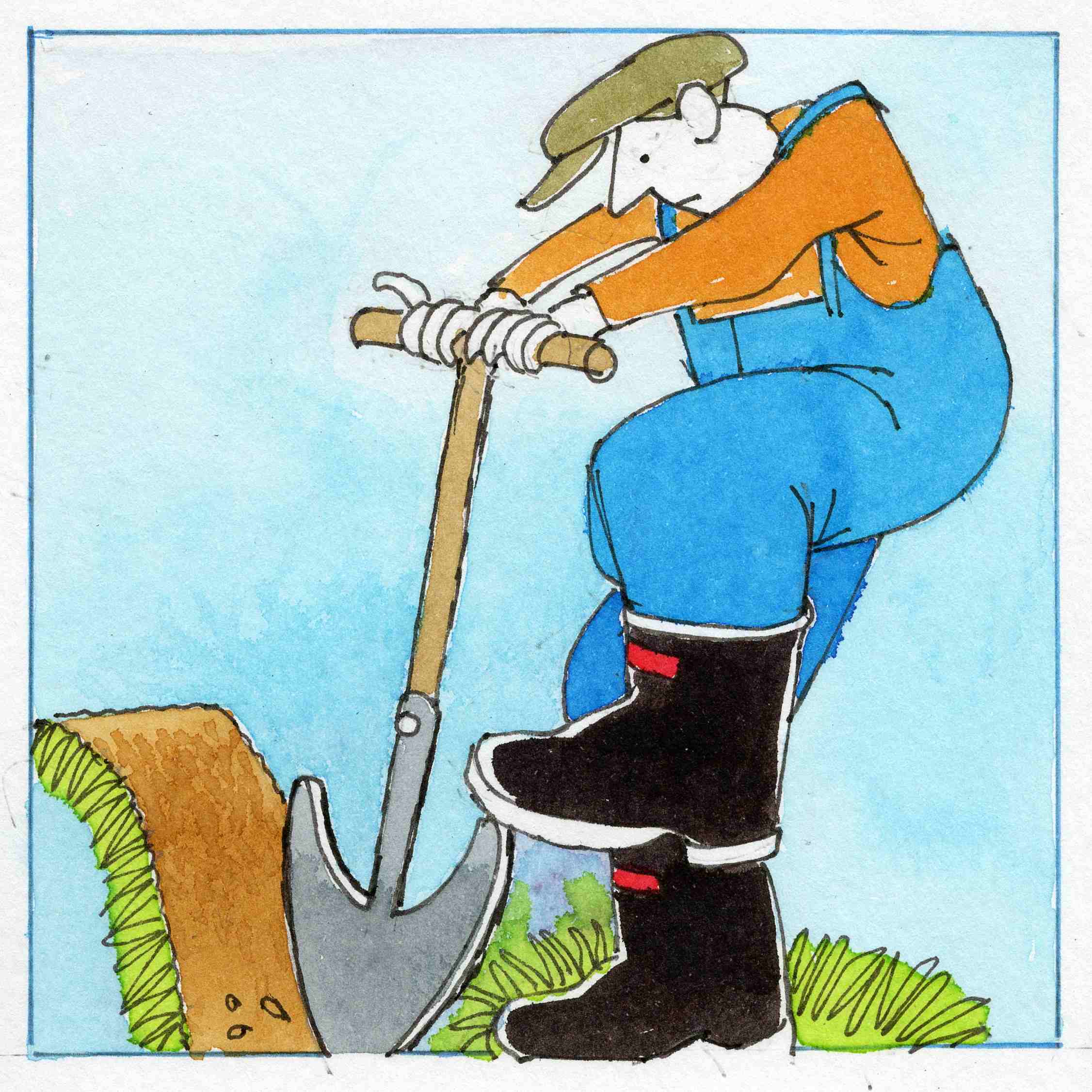
The Dictionaries of the Scots Language (DSL) tell us that to flauchter is, “to pare turf from the ground”. This is done with a flauchter-spade, which is, “a two-handed spade with a broad heart-shaped blade used for cutting surface turf”. The cut pieces of turf are flauchter-fail, fail being a Scots word for turf.
These terms have a long history. A “flauchter sped” is mentioned in the 1493 Acts of the Lord of Council and the following line appears in Christis Kirk on the Grene (c.1500): “For fantnes tha forfochin fulis Fell dounlyk flawchtir failis”.
The examples in DSL illustrate how flauchter fail was put to good use. Alexander Watt’s The Early History of Kintore includes a quote from 1733: “Such a proportion of flaughter fail … as shall ledget [provide a parapet for] the said bridge”. Another use within construction is mentioned in John Davidson’s Old Aberdeenshire Ministers (1895): “The rough undressed couples [sloping rafters], [are] covered with ‘flauchter-fail’, or broad pieces of turf and a thatching over all of heather or straw”. Meanwhile, in J. Guthrie’s Poems (1879) the purpose is food preservation: “The tatties in the pits are covered owre Wi’ routh o’ fine dry strae, and flauchtirt feal”.
Modern examples tend to occur within discussions of historical practices, as in the following from the Edinburgh Evening News in June 2017: “Three tools have been traditionally used to cut peat: a rutting spade to mark the ground, a flauchter to remove the turf and a tusker to cut the fuel”.
Dictionaries of the Scots Language would like to thank Bob Dewar for illustrating our Scots Word of the Week feature.