History of Scots to 1700
Abbreviations and conventions
References to counties in Scotland and England are to the pre-1974 counties.
The following conventions are used in discussing sounds and spellings:
< > brackets enclose graphemes (letters and combinations of letters, the latter often digraphs, i.e. combinations of two letters, such as <ch>) and spellings of words;
/ / brackets enclose phonemes (crudely, the sounds corresponding to graphemes, see below);
[ ] brackets enclose phonetic realisations (the fine details of pronunciation not usually relevant to spelling).
C stands for ‘any consonant’.
V stands for ‘any vowel’.
The symbols used are those specified by the International Phonetic Association (IPA). See Figures i-iii. In addition to those in the figures, the following symbols are used:
ʍa consonant, a voiceless labio-velar fricative, as at the beginning of where
wa consonant, a voiced labio-velar approximant, as at the beginning of wear
ʧa consonant, a voiceless affricate, as at the beginning of char
ʤa consonant, a voiced affricate, as at the beginning of jar
and the following diacritics:
n̩the consonant is syllabic, as /n/ in heaven
d̪the consonant is dental
d̥the normally voiced consonant is devoiced
e̝the vowel is raised
e̞the vowel is lowered
ε̈the vowel is centralised (i.e. backed in the case of a front vowel, fronted in the case of a back vowel)
i:the vowel is long
a̫the normally non-rounded vowel is partly rounded.
A vowel or /j/ written as a superscript after a vowel is an off-glide from that vowel, i.e. a sound that the vowel shades into towards the end of its duration.
A stressed syllable can be indicated thus: contents /’kɔntεnts/ n.pl., /kən’tεnts/ v. The stressed element of a diphthong can be indicated thus: [íu].
The following symbols are traditionally used with PreSc/ME spellings to indicate pronunciation:
ăthe vowel is short
āthe vowel is long (OE)
áthe vowel is long (ON)
ọthe vowel is raised
ęthe vowel is lowered.
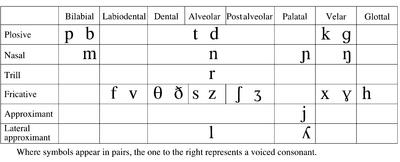
Figure i: Consonants
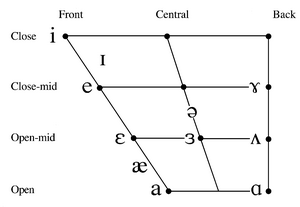
Figure ii: Non-rounded vowels
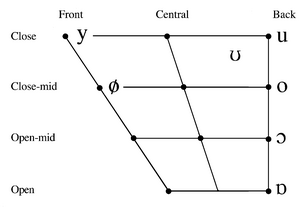
Figure iii: Rounded vowels
Abbreviations
| Abd | Aberdeen |
| AN | Anglo Norman |
| Angl | Anglian |
| Arg | Argyll |
| CF | Central French |
| Cmb | Cumbria |
| Dmf | Dumfriesshire |
| Du | Dutch |
| EModE | Early Modern English |
| ESc | Early Scots |
| EScand | East Scandinavian |
| F | French |
| f/c | forthcoming |
| Flem | Flemish |
| G | German |
| Gael | Gaelic |
| Gr | Greek |
| GVS | Great Vowel Shift |
| HOCL | Homorganic Cluster Lengthening |
| It | Italian |
| L | Latin |
| LG | Low German |
| LV | l-vocalisation |
| MDu | Middle Dutch |
| ME | Middle English |
| MF | Middle French |
| MLG | Middle Low German |
| ModE | Modern English |
| ModSc | Modern Scots |
| ModStE | Modern Standard English |
| MSc | Middle Scots |
| NE | North East |
| nEC | northern East Central |
| nME | northern Middle English |
| OE | Old English |
| OF | Old French |
| OIr | Old Irish |
| ON | Old Norse |
| ONhb | Old Northumbrian |
| OSc | Older Scots |
| OSL | Open Syllable Lengthening |
| OWScand | Old West Scandinavian |
| Port | Portuguese |
| PreSc | Pre-Scots |
| PreStE | Pre-Standard English |
| Scand | Scandinavian |
| ScStE | Scottish Standard English |
| sEC | southern East Central |
| sME | southern Middle English |
| Sp | Spanish |
| StE | Standard English |
| SVLR | Scottish Vowel-Length Rule |
| SW | South West |
| WC | West Central |
| WS | West Saxon |
| WScand | West Scandinavian |
Macafee, Caroline and †Aitken, A. J. (2002) ‘A history of Scots to 1700’ in A Dictionary of the Older Scottish Tongue vol. XII, xxix-clvii. Online https://dsl.ac.uk/about-scots/history-of-scots/abbreviations/